European Open Science Cloud (EOSC): Nodes ecosystem
The EOSC Federation is developing as more EOSC national and thematic nodes are deployed
This post is based on personal notes taken from several information events and this is not an official EOSC communication. Sign up for their EOSC newsletter is you want regular, comprehensive updates about the continuous developments in the EOSC ecosystem.
The vision of EOSC and specifically the EOSC Federation is to develop a system where any researcher in Europe can find and access data and services for research and innovation. These services include: storing, sharing, processing, analysing and reusing FAIR data within and across borders.
National and thematic nodes
Besides basic infrastructure nodes, we can distinguish between national (currently: Finland, Italy, Germany, Poland, Slovakia and Netherlands) and thematic nodes (currently: Health & Food, Physical science & engineering, environment; there can be several nodes on a specific theme). These nodes are the basic entry points into the federation data and services. Find all deployed nodes in the federation site (…but do not be surprised if you find broken links…).
For deploying a node, organizations need to undergo a process of enrollment and fulfill governance, technical, security requirements. This process is detailed in the chapter 6 of the EOSC Federation handbook.
In the page for each node you will find status & timeline updates about their level of deployment and roadmap. The level of detail and extension of this roadmap varies. See for example the roadmaps of Finland, Germany or Poland.
Exploring some available nodes
A previous blog post gave an overview of the EOSC EU Node, which was the first deployed node, as an example of what a national node could look like. It has file sync & share, virtual machines, interactive notebooks, large files transfer, etc.
Diverse range of services and access
The range of services and appearance of the node is not homogeneous (besides, of course, the requirements for enrolling as nodes). Note that the content of the national nodes rely on technical and data governance infrastructures of each country. EOSC is about reusing existing infrastructures and making them more interoperable, rather than creating new ones (which would be implausible and impractical). While metadata about the services and data are accessible to any researcher (or data steward) in EU, their access can have different levels of restrictions, and can be limited to researchers within a country or a specific project.
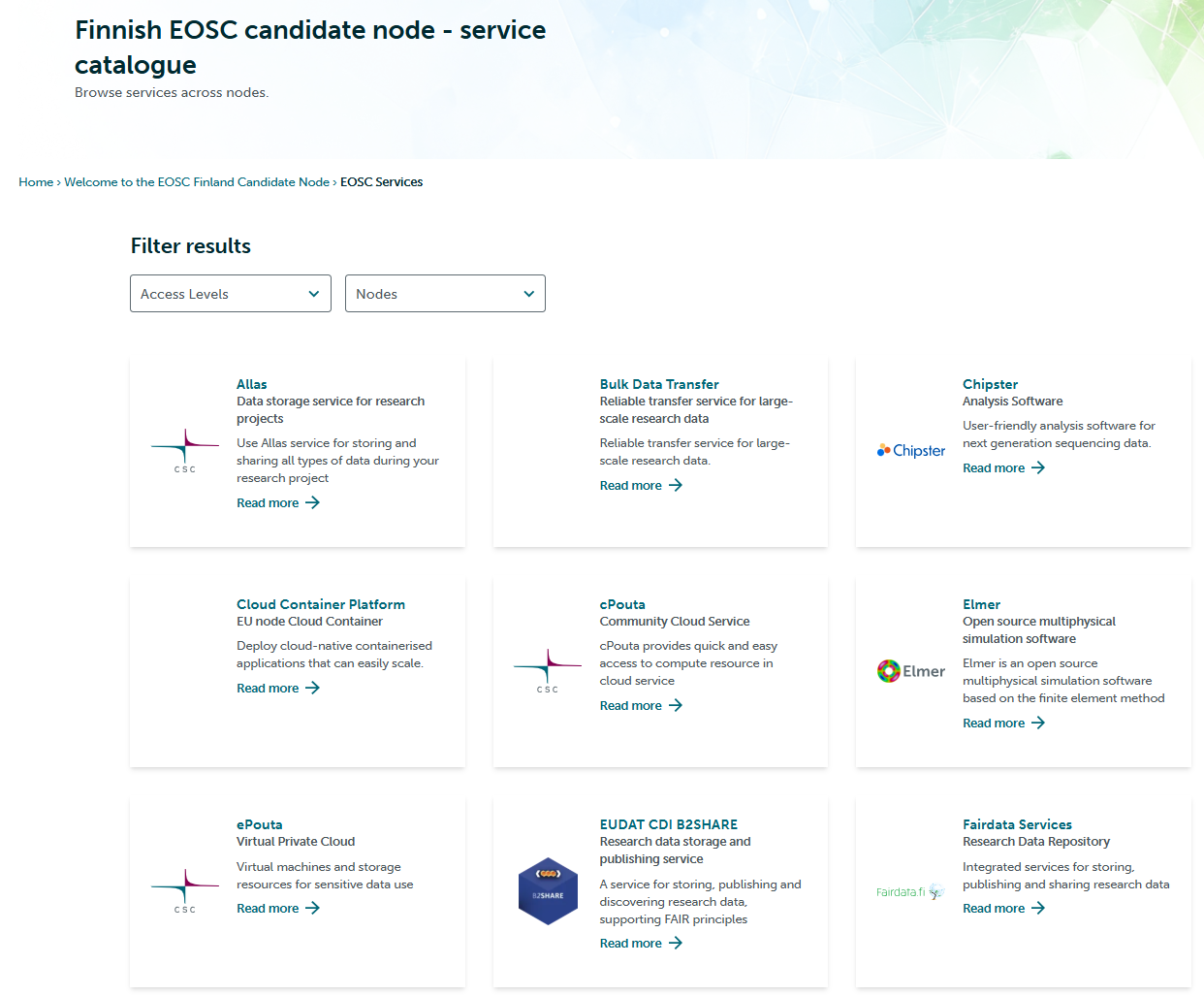
The Finnish EOSC node has an extensive catalog of services. Figure 1 shows some of these services . The node also has a very comprehensive catalog of research outputs, data and tools.
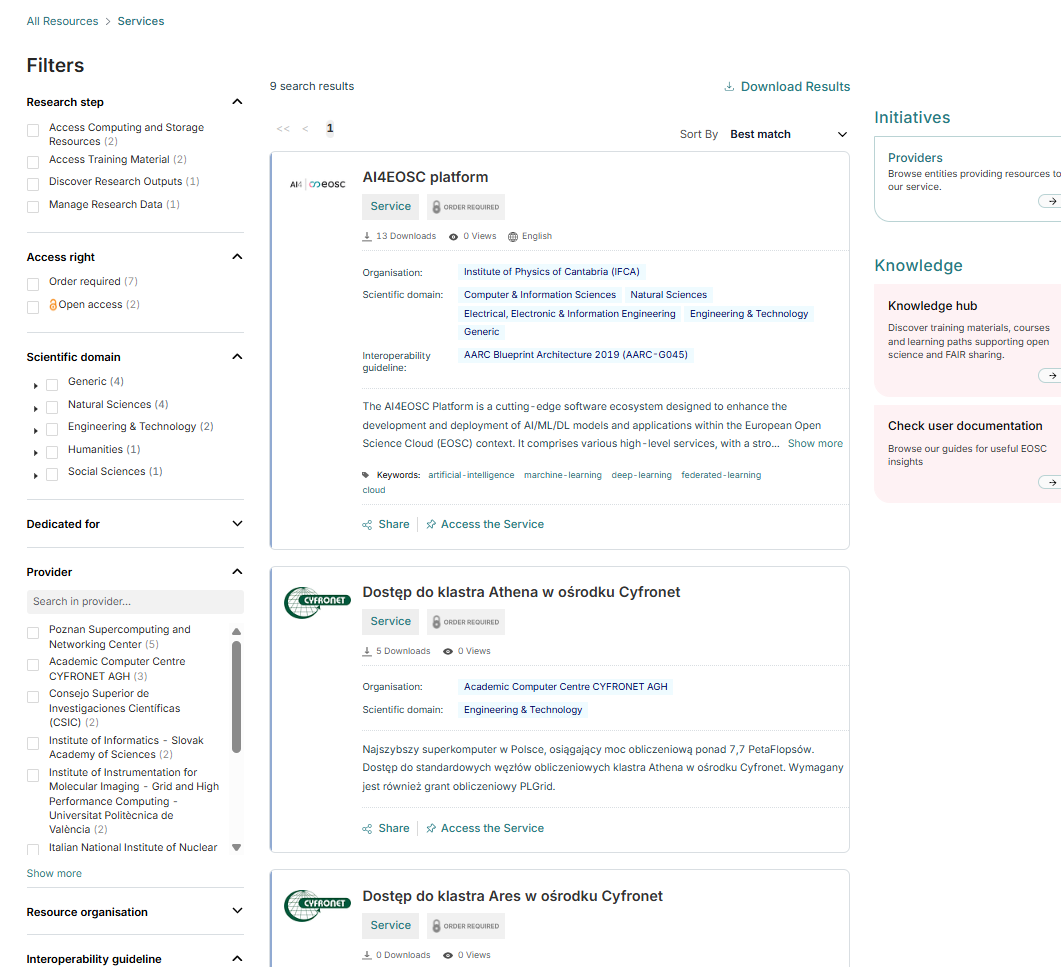
ThePolish node also has a catalog of services, data, publications and software. See screenshot Figure 2.
As mentioned, the accessibility varies, for example, for accessing the Dutch node, you need access to the SURF cloud services.
The system of credits for users
The user receives virtual credits for using services for free. They refresh every 90 days. See details in their document on access policy.The national nodes manage their credits.
Note that the credits provided for free for ‘everybody’ for example in the EU node, are not sufficient to run a research project with computational demands. however projects funded by EU commission can claim up to 40,000 credits supporting open science from the start. Find details here and in their user access policy.
What about sensitive data?
At the moment there are several ongoing initiatives from the EOSC ecosystem dealing with this:
The EOSC-ENTRUST project aims to create a European network of trusted research environments (TREs) for sensitive data. One of the results was to propose a blueprint architecture for TREs within the EOSC ecosystem (see publication).
The node EOSC Life sciences connect also includes resources and projects related to enabling ‘secure and ethically compliant’ access to life science data.
Enabling sensitive data in national nodes is still work in progress.
SENPRO: prototyping a Swiss National Node
The national initiative SENPro has the mission to desigfn and test a federated framework in Switzerland that could connect to the EOSC. It was launched in September 2025 and it is funded by Swissuniversities’ Open Science Program II. Is implemented by a multidisciplinary consortium of leading institutions and has 3 pillars:
- Community and Needs Assessments
- Technical Development and Integration
- Validation, Governance and Sustainability
Visit their website to stay up to date on their various communication and community engagement events.
As a researcher, what can you do with these EOSC nodes?
Stay tuned. Most of these infrastructures are getting started, but EOSC is priority in the policy agenda of the European Research Area and is recognised as the common European research and innovation data spaces. It will continue developing in the upcoming years, so check their news, explore the roadmaps of the nodes of your country or thematic area. Data stewards or open science services can inform you as well.
Engage with SENPro so that your needs are reflected on the Swiss Node prototype
Explore the services in nodes like the EU node and read about their Scientific Use cases like REANA and Galaxy Some of these tools are currently ready for interdisciplinary use
Data valorisation. It is possible that you already interact with infrastructures collaborating with EOSC or European Research Infrastructure Consortium (ERIC). If not, interacting with infrastructures that could potentially connect your research outputs to EOSC will add up to research valorisation and will have a positive impact in project planning, funding applications, etc. Contact your local datasteward for guidance on your discipline.