OPeR-RA: Open Research Data Management, Pre-registration, Reproducibility: Raising Awareness
a national initiative supporting rigorous, transparent and reproducible research across Switzerland, funded by swissuniversities as part of the Programme Open Science II
OPeR-RA (Open Research Data Management, Pre-registration, Reproducibility: Raising Awareness), is a national initiative supporting rigorous, transparent and reproducible research across Switzerland, funded by swissuniversities as part of the Programme Open Science II: Call for Communication and Awareness Raising Projects.
The project delivers three itinerant, hands-on workshops on reproducibility, pre-registration, and open research data management. Each workshop will be hosted at four Swiss universities (UZH, UNIGE, UNIBE and UNIL) and combines conceptual grounding with practical training.
Registration for each workshop: Free for students and employees at any Swiss university or public research institutions. For participants from the private sector, a fee of CHF 100 applies.
Overview:
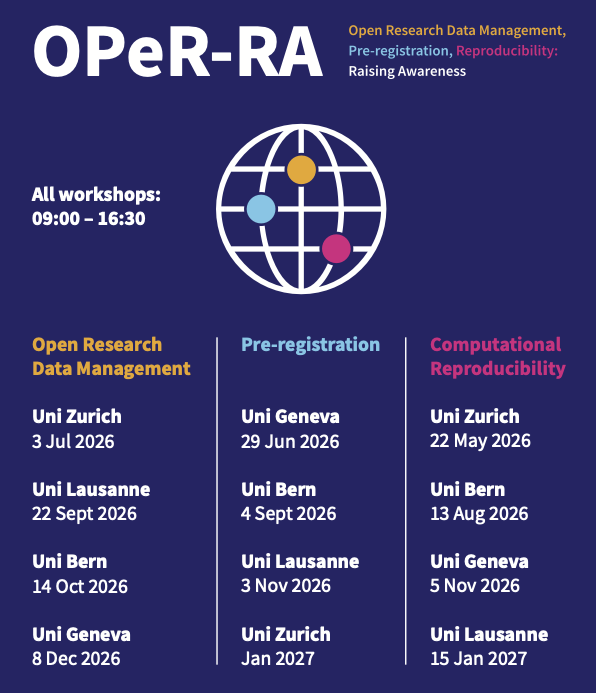
Upcoming workshops
The third Open Research Data Management workshop will take place on 08 December 2026, from 09:00 to 16:30.
Location: Uni Geneva, room tbc
Instructors: Gorka Fraga Gonzalez, Christine Krebs
Registration (by 01 December): here
More info:
This workshop will introduce the participants to best practices of research data management throughout their projects. This includes basic principles like FAIR data, national strategies, funder requirements and the handling of sensitive data. There will also be hands-on elements where we will focus on practical aspects of data management plans, handling and formatting metadata and choosing the repositories that best suit your project. Join to learn how to manage our data efficiently during your project and to navigate the challenges of open data.
This workshop will address general principles of research data management, therefore, researchers from all disciplines are welcome.
Program:
| Time | Session |
|---|---|
| 09:00 – 09:10 | Welcome and introduction |
| 09:10 – 10:00 | Foundations: Open Science; FAIR and CARE principles; Open Research Data; National ORD strategy |
| 10:00 – 10:15 | Coffee break |
| 10:15 – 12:00 | RDM in practice: part 1: Data Life Cycle; Handling Sensitive Data (intro); Data Management Plans; Research Data and AI |
| 12:00 – 13:00 | Lunch |
| 13:00 – 13:30 | RDM in practice: part 2: Publishing and Sharing; Data Support |
| 13:30 – 15:00 | RDM Hands on: part 1: Group and individual activities; Create DMP sections; Formatting tabular data |
| 15:00 – 15:15 | Coffee break |
| 15:15 – 16:00 | RDM Hands on: part 2: Creating Metadata; Reality checks |
| 16:00 – 16:30 | Closing discussion |
Past workshops
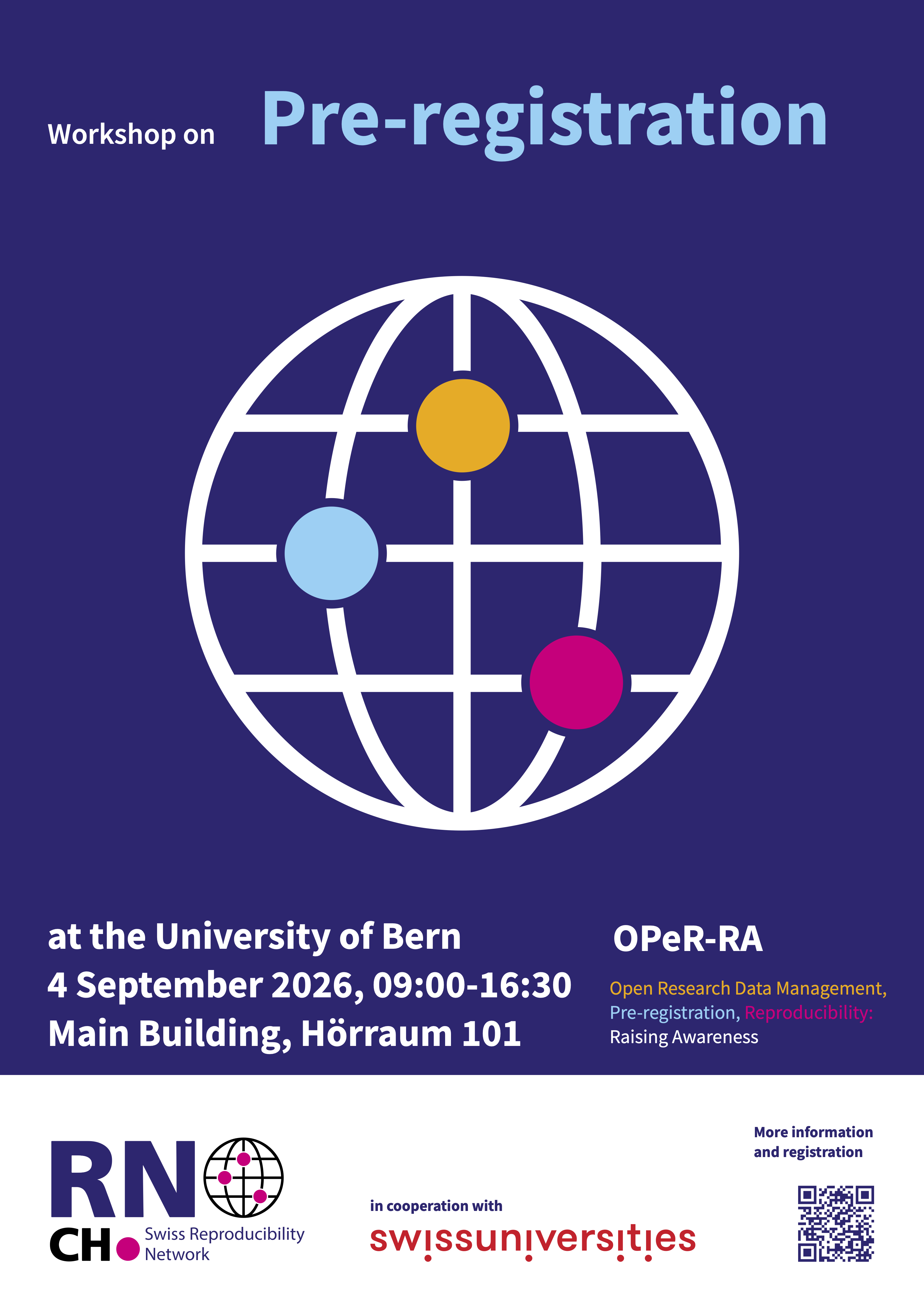
Pre-registration (Uni Bern)
Location: University of Bern, Hochschulstrasse 4, 3012, Bern - University Main Building, Room: Hörraum 101
Instructors: Hanno Würbel, Malte Elson,Nele Borgert (Uni Bern)
Registration (by 27 August): here
More info: This workshop introduces participants to preregistration and Open Science practices in research. The morning session (lecture) covers the replication crisis and questionable research practices (such as p-hacking, HARKing, and optional stopping) that motivate Open Science reforms, and provides an overview of tools and workflows for credible research. The afternoon hands-on session guides participants through the complexities of preregistration and supports them in specifying their plans in a transparent and reviewable way. The morning session can be attended independently; the afternoon session requires prior participation in the morning. Join to learn how preregistration can make your research more transparent, credible, and replication-ready.
Open Research Data Management (Uni Lausanne)
Location: Campus UNIL Sorge, Amphipôle, Room 340.1
Instructors: Gorka Fraga Gonzalez, Christine Krebs
Registration (by 18 September): here
More info: This workshop will introduce the participants to best practices of research data management throughout their projects. This includes basic principles like FAIR data, national strategies, funder requirements and the handling of sensitive data. There will also be hands-on elements where we will focus on practical aspects of data management plans, handling and formatting metadata and choosing the repositories that best suit your project. Join to learn how to manage our data efficiently during your project and to navigate the challenges of open data.
This workshop will address general principles of research data management, therefore, researchers from all disciplines are welcome.
Program:
| Time | Session |
|---|---|
| 09:00 – 09:10 | Welcome and introduction |
| 09:10 – 10:00 | Foundations: Open Science; FAIR and CARE principles; Open Research Data; National ORD strategy |
| 10:00 – 10:15 | Coffee break |
| 10:15 – 12:00 | RDM in practice: part 1: Data Life Cycle; Handling Sensitive Data (intro); Data Management Plans; Research Data and AI |
| 12:00 – 13:00 | Lunch |
| 13:00 – 13:30 | RDM in practice: part 2: Publishing and Sharing; Data Support |
| 13:30 – 15:00 | RDM Hands on: part 1: Group and individual activities; Create DMP sections; Formatting tabular data |
| 15:00 – 15:15 | Coffee break |
| 15:15 – 16:00 | RDM Hands on: part 2: Creating Metadata; Reality checks |
| 16:00 – 16:30 | Closing discussion |

Open Research Data Management (Uni Bern)
Location: Schanzeneckstrasse 1, 3012, Bern - UniS, Room: B-105
Instructors: Gorka Fraga Gonzalez, Christine Krebs
Registration (by 07 October): here
More info: This workshop will introduce the participants to best practices of research data management throughout their projects. This includes basic principles like FAIR data, national strategies, funder requirements and the handling of sensitive data. There will also be hands-on elements where we will focus on practical aspects of data management plans, handling and formatting metadata and choosing the repositories that best suit your project. Join to learn how to manage our data efficiently during your project and to navigate the challenges of open data.
This workshop will address general principles of research data management, therefore, researchers from all disciplines are welcome.
Program:
| Time | Session |
|---|---|
| 09:00 – 09:10 | Welcome and introduction |
| 09:10 – 10:00 | Foundations: Open Science; FAIR and CARE principles; Open Research Data; National ORD strategy |
| 10:00 – 10:15 | Coffee break |
| 10:15 – 12:00 | RDM in practice: part 1: Data Life Cycle; Handling Sensitive Data (intro); Data Management Plans; Research Data and AI |
| 12:00 – 13:00 | Lunch |
| 13:00 – 13:30 | RDM in practice: part 2: Publishing and Sharing; Data Support |
| 13:30 – 15:00 | RDM Hands on: part 1: Group and individual activities; Create DMP sections; Formatting tabular data |
| 15:00 – 15:15 | Coffee break |
| 15:15 – 16:00 | RDM Hands on: part 2: Creating Metadata; Reality checks |
| 16:00 – 16:30 | Closing discussion |

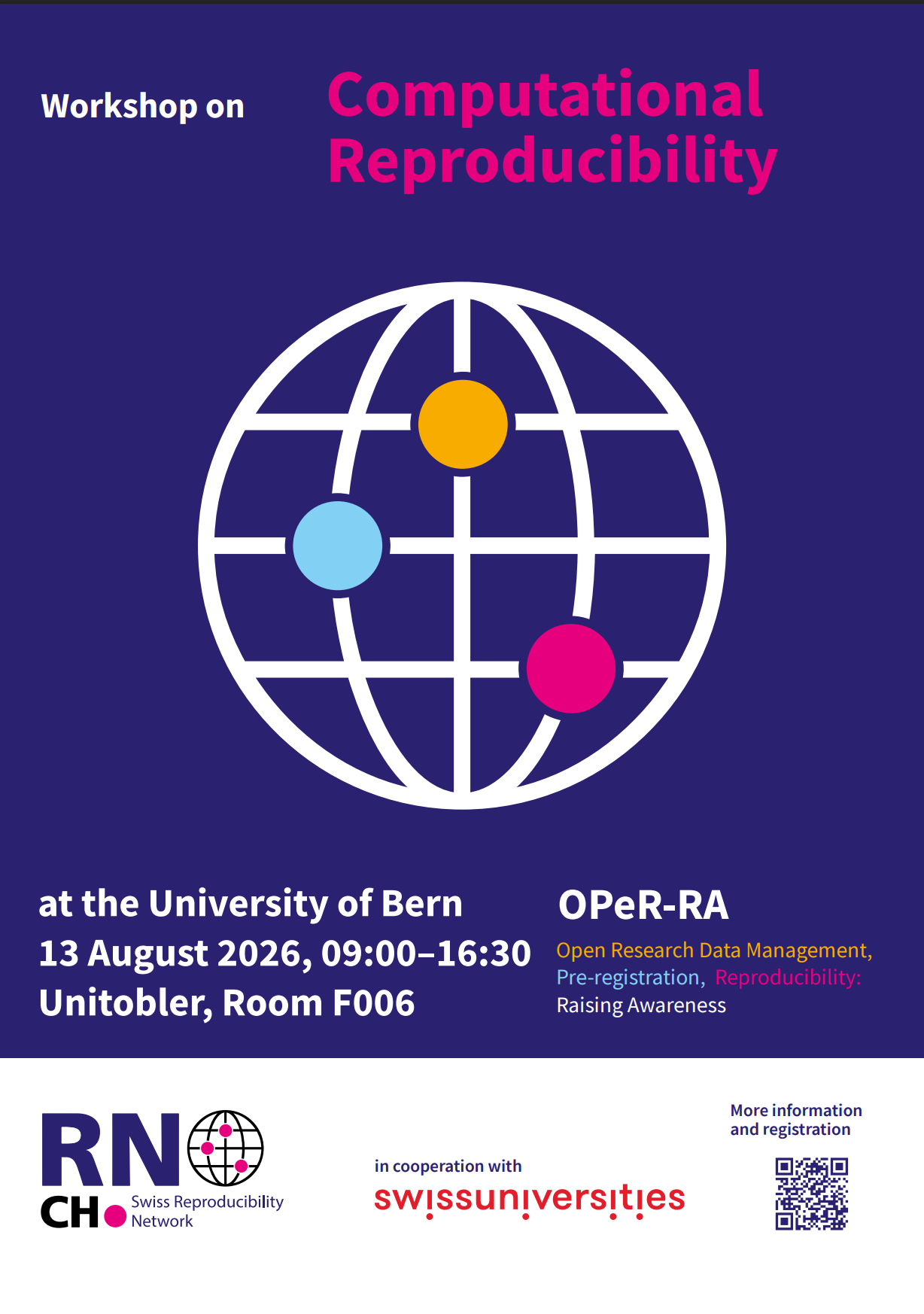
Location: University of Bern, Lerchenweg 36, 3012 Bern, Room: F 006 Unitobler
Instructors: Aleksandar Bobic (ETHZ), Fabio Molo (UZH), Daniel Stekhoven (ETHZ)
Registration (by 10 August): here
More info: The workshop will introduce the participants to a full pipeline for creating and sharing computationally reproducible data analyses. The pipeline includes version control with Git, reproducible reports with Quarto using R or Python, analysis workflow management, Docker software containers, and best practices for publishing the analysis. For each of these elements we provide a short theoretical introduction, and together we will work through a hands-on example analysis across the entire pipeline. Join to learn how to make your analyses (more) transparent, shareable, and reproducible.
Target audience: Researchers and students at any level who conduct data analyses in any field.
Program outline
| Time | Session |
|---|---|
| 09:00 | Welcome, framing, introduction to reproducibility |
| 10:00 | Version control (git) |
| 11:00 | Dynamic reporting (Quarto + R/Python) |
| 12:30 | Lunch |
| 13:30 | Workflow management (snakemake + nextflow) |
| 14:30 | Containers (Docker) |
| 15:45 | Publishing and sharing with a DOI |
| 16:30 | End of workshop |
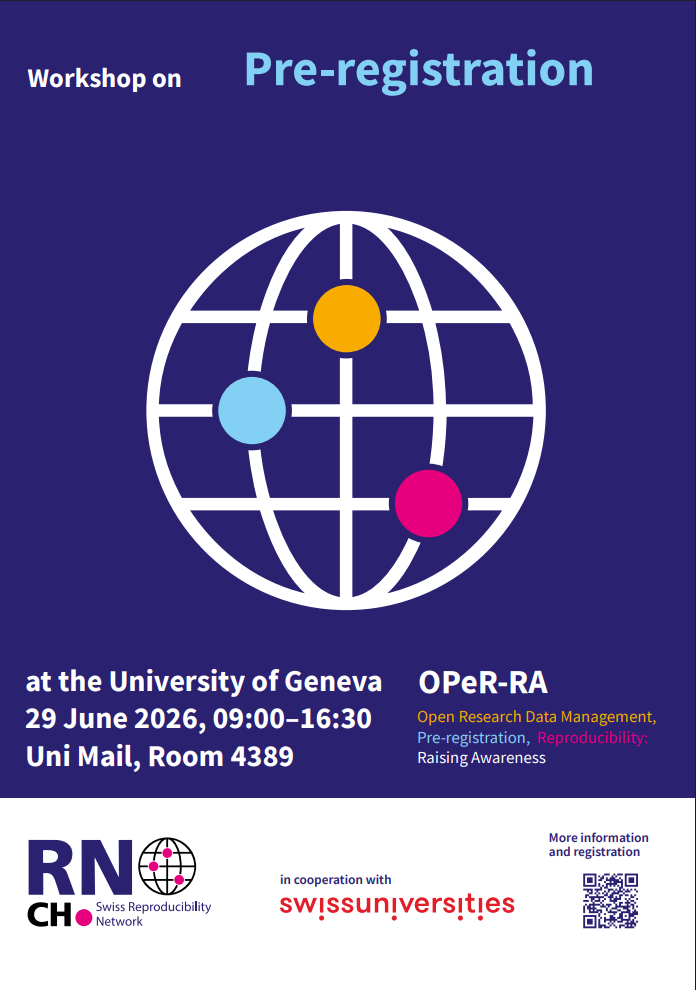
This workshop introduces participants to preregistration and Open Science practices in research. The morning session (lecture) covers the replication crisis and questionable research practices (such as p-hacking, HARKing, and optional stopping) that motivate Open Science reforms, and provides an overview of tools and workflows for credible research. The afternoon hands-on session guides participants through the complexities of preregistration and supports them in specifying their plans in a transparent and reviewable way. The morning session can be attended independently; the afternoon session requires prior participation in the morning. Join to learn how preregistration can make your research more transparent, credible, and replication-ready.
Registration form: click here to register
This workshop will introduce the participants to best practices of research data management throughout their projects. This includes basic principles like FAIR data, national strategies, funder requirements and the handling of sensitive data. There will also be hands-on elements where we will focus on practical aspects of data management plans, handling and formatting metadata and choosing the repositories that best suit your project. Join to learn how to manage our data efficiently during your project and to navigate the challenges of open data.
This workshop will address general principles of research data management, therefore, researchers from all disciplines are welcome.
Registration form: click here to register
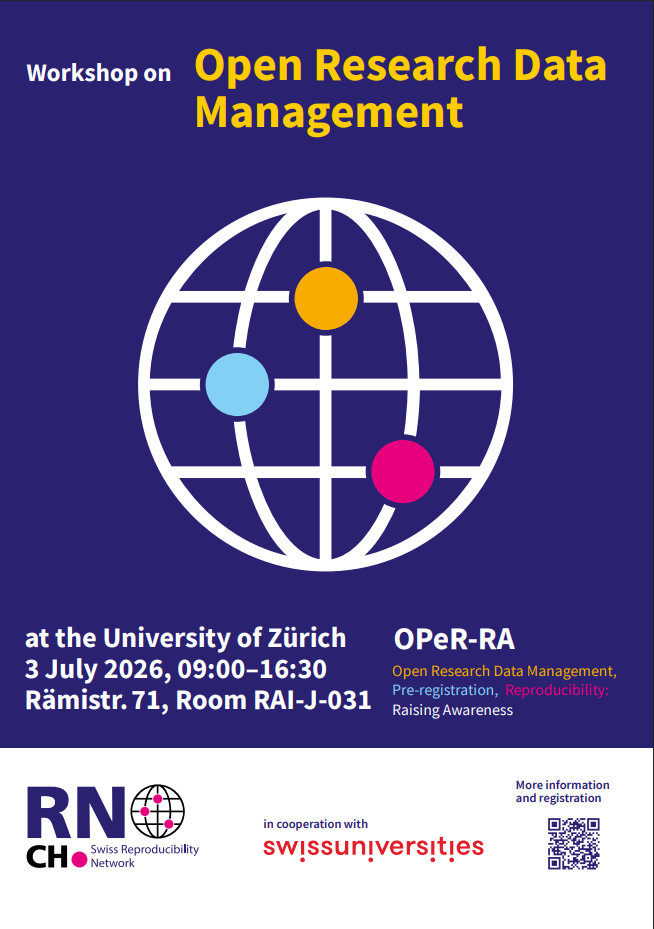
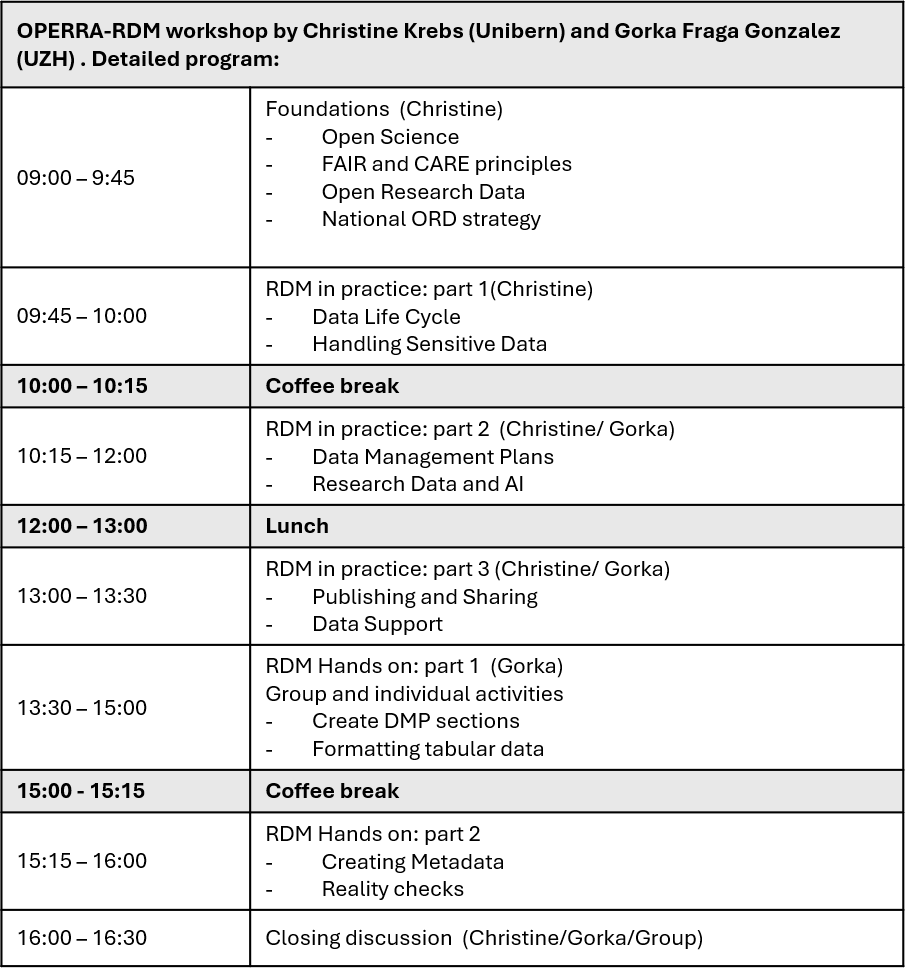
See detailed program below (click to expand)
More info on the Pre-registration and Open Research Data Management workshops: Coming up soon!
Led by experts from UZH, ETH Zurich, and the University of Bern, OPeR-RA strengthens research quality and collaboration across the Swiss research landscape
